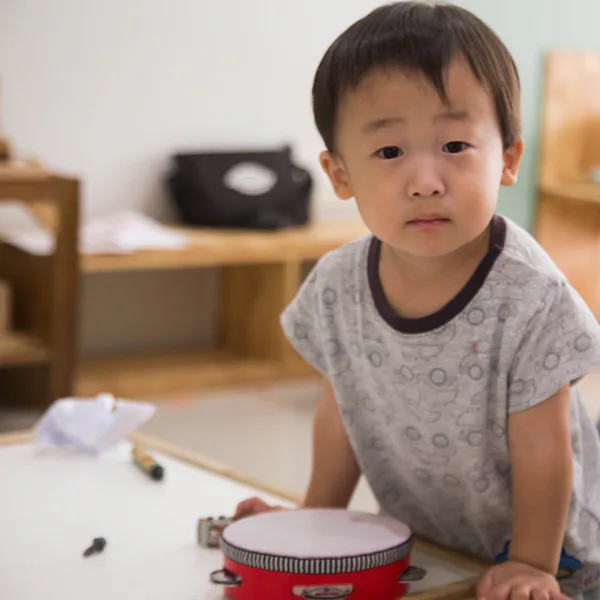
Screen Free Learning for Young Children
Young children learn through relationships, movement, conversation, and hands-on exploration. A screen can show a picture of a ball rolling, but it cannot replace the experience of pushing a real ball, watching where it goes, hearing a parent describe the action, and trying again. Screen-free learning makes room for those full-body experiences.
This does not require a house full of educational toys. A caregiver’s face, voice, hands, and attention are powerful learning tools. Cups, blocks, spoons, scarves, boxes, picture books, and ordinary routines can also become useful materials when an adult brings a clear purpose to the activity.
What screen-free learning means
Screen free learning is active learning that happens without a child watching or tapping a device. The child may move, talk, listen, sort, build, imitate, pretend, count, remember, or solve a simple problem. An adult often joins the activity by responding to the child, naming what is happening, asking a question, or offering a small hint.
The goal is not to keep a child busy with a different kind of entertainment. It is to create an experience in which the child does the thinking.
This distinction matters because early learning is social. Babies reach out through looks, sounds, gestures, and cries. Toddlers point, repeat actions, bring objects to adults, and ask questions. When a caregiver notices and responds, the exchange gives the child information about language, cause and effect, emotions, and the way conversations work.
Why real-world interaction matters
The American Academy of Pediatrics emphasizes that infants learn best from real-world interaction. For older toddlers and preschoolers, the quality and context of media matter, but screens can still displace talking, reading, moving, sleeping, and playing with other people.
Screen-free time protects space for those experiences. It lets a child feel the weight of an object, adjust a grip, judge a distance, wait for a turn, read a facial expression, and hear language connected to something happening in the moment. These details are difficult to reproduce on a flat display.
Kognara organizes this kind of learning into short, parent-led activities called Neural Missions. Each mission has a developmental focus and can be folded into an ordinary day. The approach begins with face-to-face interaction in infancy and grows into memory, language, number, planning, and reasoning games for children up to age six.
Start with the skill that is developing now
Screen-free learning works best when the challenge matches the child. A newborn does not need a sorting game. A four-year-old needs more than watching a high-contrast card.
During the first months, useful activities are simple. Hold your face within the baby’s comfortable viewing range, talk softly, pause after a sound, or slowly move a bold black-and-white pattern. These experiences support attention to faces, voices, and visual contrast.
From about two to six months, babies become more intentional. They turn toward sounds, reach for objects, and discover that their movements can make something happen. Supervised tummy time, safe reaching games, gentle rhythm, mirrors, and varied textures give them ways to connect sensation with action.
During the second half of the first year, babies begin searching for hidden objects, imitating gestures, following another person’s point, and taking part in simple back-and-forth games. Peek-a-boo, rolling a ball, clapping patterns, naming familiar objects, and hiding a toy under a cloth all fit this stage.
Between one and two years, symbolic thought begins to expand. A toddler may feed an empty spoon to a stuffed animal or copy an action seen earlier. Pretend play, body-part games, containers that open and close, and simple hiding games connect memory, language, and problem-solving.
From two to four years, children can work with patterns, categories, stories, quantities, and rules. They can sort objects, continue a clap-stomp pattern, count crackers, copy a block structure, tell part of a story, and freeze when music stops.
From four to six years, activities can include sound games, story retelling, simple planning, fair sharing, rule switching, listening walks, and explaining how they know an answer.
Keep activities short and responsive
Young children do not need long lessons. Five focused minutes can be useful when the child is alert and interested. Stop when the child turns away, becomes tired, or grows frustrated. Repeating a favorite game is not wasted time. Repetition lets a child predict what will happen and notice more detail.
Follow the child’s response instead of pushing through a script. If a baby looks away, pause. If a toddler invents a new way to sort the objects, ask about the rule. If a preschooler gives an unexpected answer, ask, “How did you figure that out?” The answer may reveal more thinking than a correct response alone.
Use language that adds information
Talk about what the child can see and do. Instead of saying, “Put it there,” try, “Place the small red block on top of the wide blue block.” During cleanup, compare which basket has more toys. While dressing, name what goes under, over, inside, and beside. While walking, listen for sounds that are near, far, loud, or soft.
This kind of language connects words to space, quantity, sequence, and cause. It also gives children vocabulary they can use to describe their own ideas.
Make the routine sustainable
A screen-free plan should reduce pressure, not add another impossible task. Choose one routine that already happens every day. Talk during diapering. Count fruit at snack time. Sort socks while folding laundry. Tell a three-part story in the car. Play a memory game before dinner. Take a listening walk after school.
Kognara’s Neural Missions are designed around this principle: read the activity, put the device down, and connect with the child. The learning happens in the exchange between the child, the adult, and the real world.
Always review an activity before beginning, supervise closely, and choose materials that are safe for the child’s age and habits. Keep small objects away from children who may mouth them, consider allergies and physical limitations, and stop any activity that causes discomfort.
The strongest screen-free learning habit is simple. Notice what interests the child, join them, add a useful word or question, and give them time to respond.