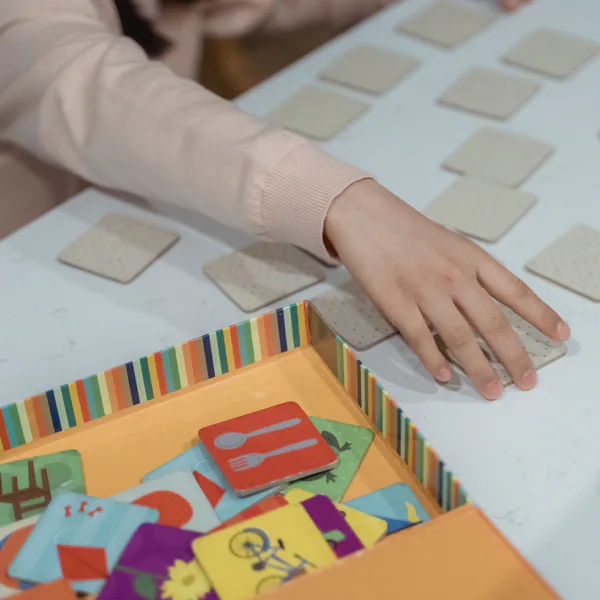
How to Improve Your Child’s Memory Through Play
Parents often ask how to improve a child’s memory, especially when a child forgets directions, loses track of belongings, or cannot retell what happened. Memory is not one single ability. Children use different systems to recognize familiar people, recall events, remember locations, hold instructions in mind, and compare what they see now with what they saw moments ago.
Play can give these systems practice, but it should not be sold as a guaranteed way to raise intelligence or produce broad academic gains. Research on memory training shows that children often improve on the kinds of tasks they practice, while transfer to unrelated skills is less certain. The practical goal is to build useful habits: paying attention, organizing information, recalling it, and using strategies.
Begin with attention
Information is difficult to remember if the child never attended to it clearly. Before asking a child to remember, reduce background distractions and make sure the child knows what matters.
For a visual game, name each object as it is placed. For a direction, make eye contact and use a short sequence. For a story, pause to identify the main event. Attention does not have to be silent or still, but it does need a target.
Match the game to the child’s age
Babies practice memory when they anticipate a familiar song, search for a partly hidden toy, or expect a caregiver to reappear during peek-a-boo. Toddlers can remember where an object was hidden or copy a familiar action after a short delay. Preschoolers can hold several objects, rules, or story events in mind.
Kognara’s Neural Mission Series follows this progression. Object-hiding games appear during infancy, spatial memory games grow more complex in the second year, and visual working-memory, sequence, and retelling activities appear during the preschool years.
Play the memory tray
Place two or three familiar objects on a tray. Name them and let the child look for about ten seconds. Cover the tray and remove one object. Uncover it and ask what is missing.
If the child struggles, use fewer objects or give a category clue. If the child answers easily, add one object or move an item instead of removing it. Asking “What changed?” requires the child to compare the current arrangement with a stored mental image.
Use a hidden-cup game
For a toddler, hide a large, safe toy under one of two cups while the child watches. Ask where it is. When that becomes easy, add a third cup or slowly switch two positions.
The game combines attention with spatial working memory. Keep the movement slow enough to follow. The purpose is not to fool the child; it is to create a challenge the child can solve with effort.
Practice deferred imitation
Show a short action, such as tapping a block, turning it over, and placing it in a bowl. Wait briefly, then offer the same materials and ask, “Do you remember what I did?”
Begin with one step. Add a second only after the first is familiar. You can also use meaningful routines, such as putting a toy animal to bed or packing a small bag. Actions tied to a simple story can be easier to organize and recall.
Tell stories in order
Narrative gives memory a structure. Ask a child to describe what happened first, next, and last. Use three pictures, a familiar book, or an event from the day.
Avoid turning the conversation into an interrogation. Add prompts that support retrieval: “We put on our shoes, and then where did we go?” Over time, use fewer clues.
Retelling also helps adults see what the child understood. A child may remember a vivid detail but miss the cause of an event. Ask, “Why did that happen?” or “What changed after that?”
Give directions the child can hold
Working memory is used when a child follows a direction with several steps. Start with one clear step, then move to two related steps: “Get your shoes and bring them to the door.”
Ask the child to repeat the plan before starting. This is not about obedience alone. Repeating converts the direction into the child’s own words and creates another memory cue.
For longer routines, use a visual sequence or consistent order. External supports do not weaken memory. They reduce overload and teach organization.
Add movement and rhythm
Clapping patterns, action songs, and movement sequences combine auditory and motor memory. Clap once, pause, and invite the child to copy. Build to clap-stomp or two slow claps and one tap.
Rhythm groups information into a predictable pattern. That is one reason songs and rhymes are easier to remember than disconnected words.
Ask the child to teach
Older preschoolers can strengthen understanding by explaining a familiar task. Ask the child to teach you how to build a structure, play a game, or complete a routine.
Teaching requires the child to retrieve the steps, place them in order, monitor what the listener knows, and notice what was omitted. If the explanation is incomplete, ask a genuine question rather than taking over.
Use helpful memory strategies
Children can learn simple strategies instead of relying on effort alone.
Repeat the information aloud.
Group similar items together.
Create a picture in the mind.
Connect new information to something familiar.
Use first next last for a sequence.
Place needed objects in a consistent location.
Break a long instruction into shorter parts.
Model these strategies openly. Say, “I need to remember keys, lunch, and a book. I am picturing all three by the door.”
Increase difficulty one step at a time
Useful memory practice sits between automatic success and constant failure. Add one object, one action, a slightly longer delay, or a small distraction. Do not increase everything at once.
If frustration rises, make the task easier. Children learn more from a manageable challenge they want to repeat than from a difficult test they begin to avoid.
Sleep, movement, stress, hunger, and emotion also affect memory. A tired or upset child may remember less in that moment without having a memory problem.
Kognara’s screen-free activities make memory visible through play: finding a hidden object, noticing what changed, copying an action, sequencing a story, and recalling the day. These activities give families practical ways to exercise attention and recall without a screen or worksheet.
If memory difficulties interfere with daily life, learning, or communication, or if a child loses a previously learned skill, speak with a qualified health or education professional. Play can support development, but it is not a diagnosis or treatment.